
For researchers, athletes, and families seeking answers.
Every Impact.
A Longer View.
Understanding head impact exposure means looking beyond a single practice or game. OMNi is developing technology to help build individual impact histories across sessions and seasons. Our long-term goal is to give researchers more detailed exposure data to study alongside health information, helping advance understanding of repeated head impacts and brain health.
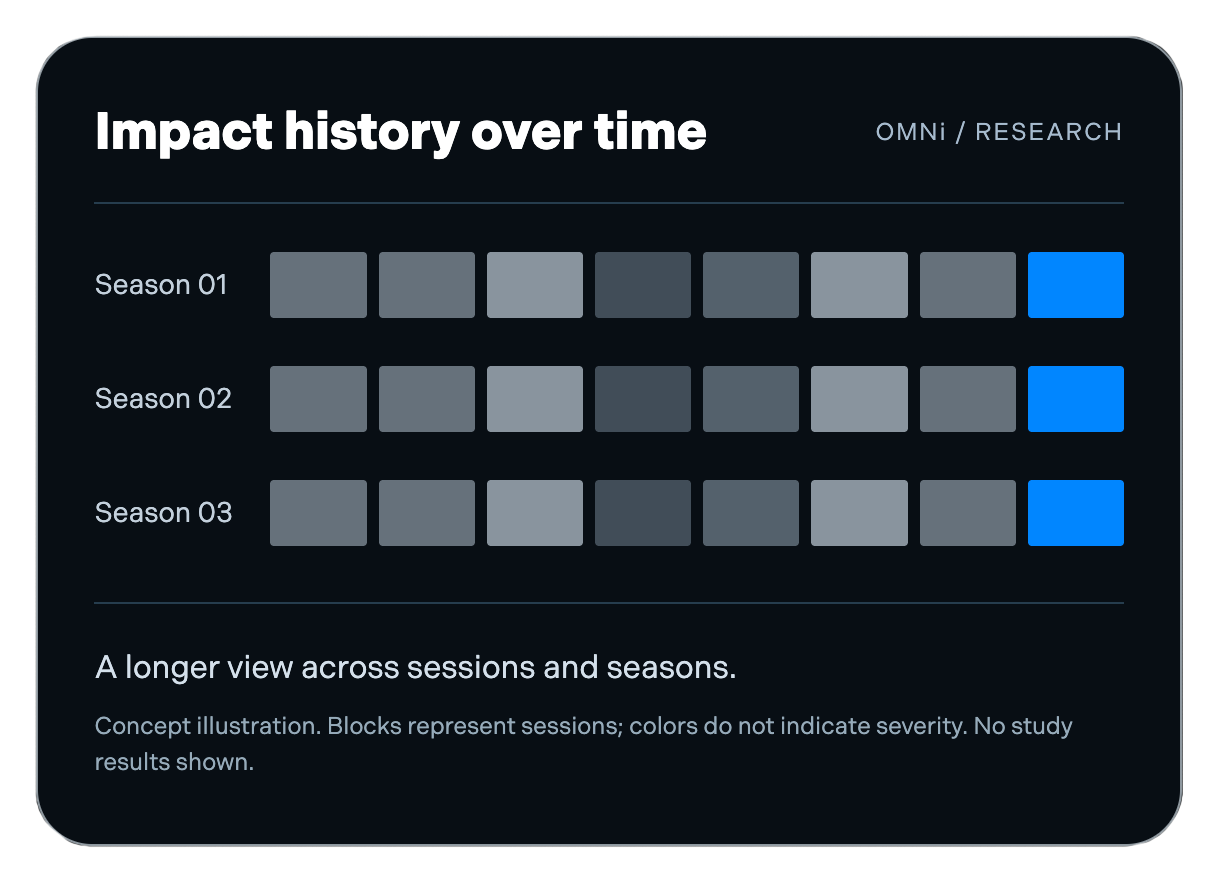
Research vision · Technology in development
THE OPPORTUNITY
Why long-term
impact data matters
A 2023 study used published helmet-sensor data to estimate lifetime exposure in former football players and found associations between estimated cumulative exposure and CTE pathology.
An athlete’s exposure can vary across practices, games, and seasons. Tracking these changes creates a more detailed picture than looking at a single session. Our goal is to help researchers study those records alongside separately collected health assessments and investigate how exposure patterns relate to outcomes over time. [2]
WHAT WE’RE WORKING TOWARD
How OMNi Could Support Research
01 / RECORD
Build Individual Impact Histories
Develop records of detected impact events and their measurements, organized by athlete and session.
02 / PATTERN
Follow Exposure Over Time
Examine how recorded impact frequency and magnitude vary across practices, games, and seasons.
03 / CONTEXT
Connect Exposure With Health Research
Work toward studies that compare impact histories with separately collected health assessments, with appropriate participant consent.
Supporting CTE research
The questions driving CTE research
Chronic traumatic encephalopathy, or CTE, is a brain disease associated with long-term exposure to repeated head impacts. These impacts can occur with or without concussion symptoms. Researchers
are still investigating how the disease develops and why some people with a history of repeated exposure are affected while others are not.
OMNi’s goal is to contribute detailed impact histories that researchers could use as one part of that investigation. [1]
01 How does recorded exposure vary across practices, games, and seasons?
02 How do impact frequency and magnitude contribute to those patterns?
03 How might those patterns relate to brain health over time?
Sensor measurements describe recorded motion associated with impacts. They do not directly measure brain injury. OMNi and the OMNi Brain Load Score (OBLS) are not validated tools for diagnosing concussion or CTE, predicting an individual’s future disease risk, or determining whether an athlete is safe to play.
CTE currently requires examination of brain tissue after death for confirmation. [1]
BUILDING THE FOUNDATION
Where we are today
TODAY
Developing and Testing
We are developing the sensor and companion app. Our next steps include evaluating measurement accuracy, consistency, and performance in the intended helmet setups.
NEXT
Defining Useful Research Data
We are seeking input from researchers on the measurements, testing methods, and data formats needed for meaningful studies.
LONG TERM
Supporting Studies Over Time
Our goal is to support research that follows participants over time, with clear consent, privacy protections, and agreements governing data use.
RESEARCH AND FURTHER READING
Background research informing our mission. These sources do not validate OMNi or the OMNi Brain Load Score.
[1] CDC: About Repeated Head Impacts.
[2] Daneshvar et al., Nature Communications (2023). Leveraging football accelerometer data to quantify associations
between repetitive head impacts and chronic traumatic encephalopathy in males.
Moving forward together.
LET’S BUILD THE NEXT CHAPTER
Help shape the research
We’d like to connect with researchers, universities, and clinical teams studying repetitive head impacts and long-term brain health.
Tell us what you’re investigating and what data would help move your work forward.
